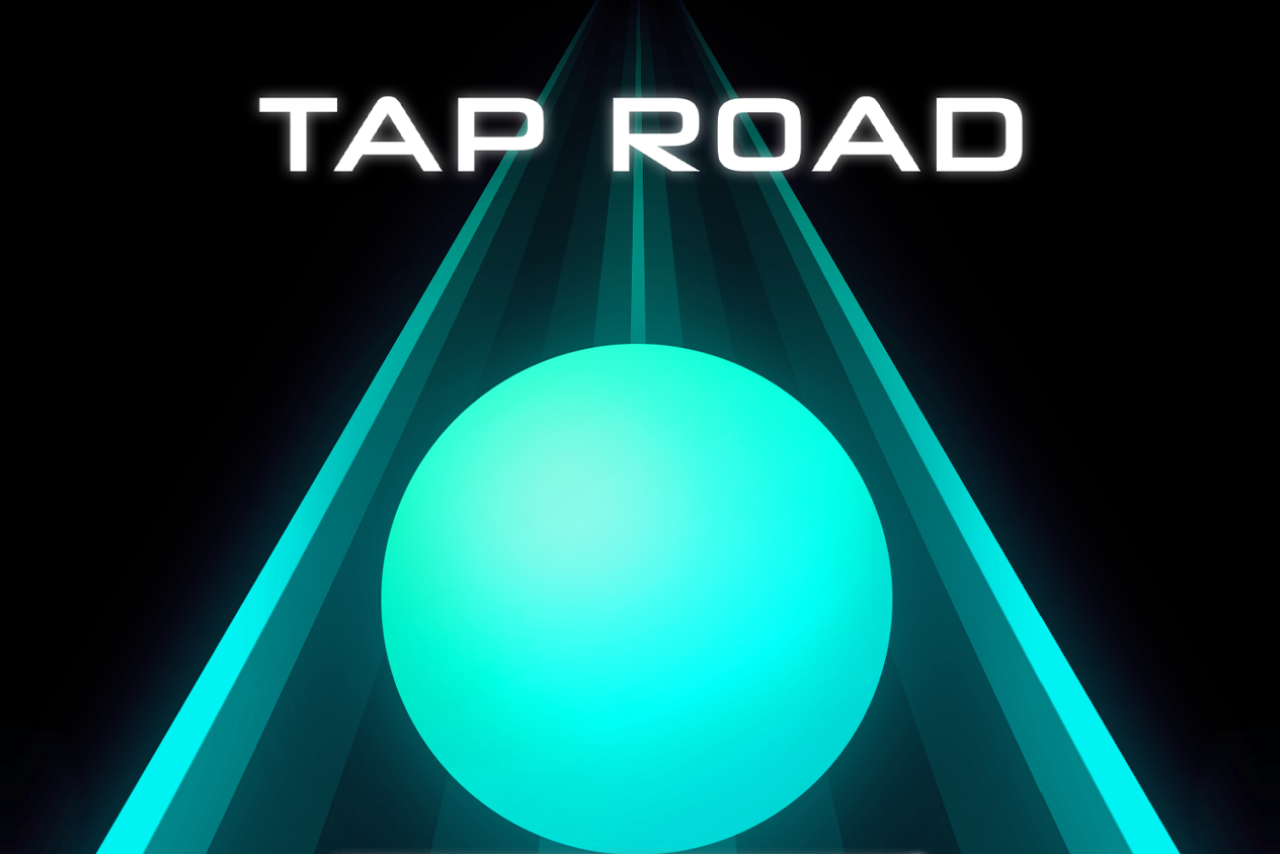
The Rise of the Reflex Runner
In the vast landscape of online arcade gaming, few genres capture the essence of pure, adrenaline-fueled focus quite like the endless runner. Among these digital gauntlets, a new challenger has emerged to test the limits of your reaction time and rhythmic precision. We are talking, of course, about Tap Road.
At first glance, the premise seems deceptively simple: guide a rolling sphere along a twisting, neon-lit track that stretches into infinity. There are no complex button combinations to memorize, no expansive skill trees to manage, and no heavy narrative to bog you down. There is only the road, the ball, and your ability to react. Yet, beneath this minimalist exterior lies a profound challenge that has captivated players worldwide, turning casual breaks into intense sessions of "just one more try."
This article dives deep into the mechanics, strategies, and psychological appeal of this addictive title. Whether you are a newcomer struggling to pass the first hundred meters or a seasoned veteran chasing a global high score, understanding the nuances of Tap Road is the key to unlocking your full potential.
Anatomy of the Challenge: Mechanics and Design
To master the game, one must first understand the rules of engagement. Tap Road strips away the clutter of modern gaming to focus on a singular mechanic: the tap.
The One-Touch Philosophy
The beauty of the game lies in its accessibility. The controls are binary—you tap, and the ball changes direction. This one-touch system means that the barrier to entry is virtually non-existent. You don't need a gaming controller or a high-end PC; you simply need a device with a screen or a mouse. However, this simplicity is a double-edged sword. Because the input is so simple, the game demands absolute perfection in execution. A millisecond of hesitation or a premature click results in an immediate game over, sending your ball plummeting into the virtual abyss.
The Procedural Abyss
Unlike platformers where you can memorize level layouts, Tap Road utilizes procedural generation. This means the track is built in real-time as you play. No two runs are exactly the same. One run might offer a gentle series of long straightaways, while the next throws a chaotic sequence of sharp zig-zags immediately out of the gate. This unpredictability prevents players from relying on muscle memory for specific patterns, forcing them instead to rely on raw reflex and adaptability.
Speed and Escalation
The difficulty curve in Tap Road is subtle but relentless. As you progress, the speed of the ball incrementally increases. The visual feedback of the scrolling track creates a hypnotic effect, often referred to as "tunnel vision." As the velocity ramps up, the window of opportunity for each turn shrinks. What starts as a leisurely roll quickly transforms into a high-speed survival horror where your brain must process visual information faster than your conscious mind can articulate.
The Psychology of Flow: Why We Can't Stop
Why do we subject ourselves to such punishing difficulty? The answer lies in a psychological concept known as "Flow." Coined by psychologist Mihaly Csikszentmihalyi, a flow state is a mental zone of energized focus, full involvement, and enjoyment in the process of the activity.
Tap Road is a perfect "Flow engine." The immediate feedback loop—survive or die—keeps the brain fully engaged. There is no downtime, no loading screens between failures, and no inventory management to break the immersion. When you are in the zone, the outside world fades away. You aren't thinking about your grocery list or your emails; you are entirely consumed by the rhythm of the track.
This state is incredibly rewarding for the human brain. The satisfaction of nailing a difficult sequence of turns releases dopamine, the brain's "feel-good" chemical. Conversely, the frustration of a near-miss creates a "tension gap" that we feel compelled to close by trying again. This cycle of tension and release is what makes Tap Road so incredibly difficult to put down.
Strategic Mastery: Beyond Pure Reflexes
While reflexes are the foundation of success, strategy is the architecture. mindless tapping will only get you so far. To crack the upper echelons of the leaderboards, you need to employ specific techniques.
1. The Anchor Point Technique
Novice players often stare directly at the ball. This is a mistake. By the time you see the ball reach a corner, it is often too late to react effectively at high speeds. Instead, shift your gaze slightly ahead of the ball—about an inch or two on the screen. This allows you to "read" the road before the ball arrives, giving your brain precious extra milliseconds to prepare the tap. You are essentially buffering the command in your mind before executing it.
2. Rhythm Over Reaction
The most successful runs often feel more like playing a musical instrument than playing a video game. The track layout often follows rhythmic patterns—tap, tap, wait, tap, tap, tap. If you can internalize this rhythm, you stop reacting to individual corners and start "flowing" through sections. Many top players recommend listening to high-tempo music while playing Tap Road, as the beat can help synchronize your tapping cadence.
3. Managing the "Panic Tap"
We have all been there: the track suddenly throws a complex zig-zag pattern, panic sets in, and we start mashing the screen uncontrollably. This is the quickest way to end a run. The game requires deliberate, distinct inputs. Rapid-fire tapping usually results in an over-correction, sending the ball off the other side of the track. When the track gets chaotic, consciously try to slow down your internal clock. Take a breath and focus on distinct, singular inputs rather than a flurry of clicks.
4. Screen Real Estate
Where you tap matters. On mobile devices, ensure your hand isn't obscuring the upcoming track. On desktop, keep your mouse cursor away from the center of the action. It sounds trivial, but visual obstructions are a leading cause of "unforced errors" in the game.
The Technical Advantage: Browser Gaming in 2025
One of the standout features of Tap Road is its platform. As a browser-based game, it represents the renaissance of the "unblocked" arcade era.
In an age where games often require 100GB downloads, hefty graphic cards, and constant updates, the lightweight nature of this title is refreshing. It respects the user's time and resources. Whether you are on a Chromebook at school, a mobile phone on the subway, or a workstation during a lunch break, the game is instantly accessible.
This accessibility also fosters a unique competitive environment. Because anyone can play it anywhere, the leaderboard represents a true cross-section of global players. You aren't just competing against people with expensive consoles; you are competing against office workers, students, and casual gamers from every continent.
Furthermore, the technology behind modern browser games has evolved. The latency issues that plagued Flash games of the early 2000s are largely gone. Tap Road utilizes modern web standards to ensure that the input lag is minimal, a critical factor for a game that relies on split-second timing.
Training Your Brain: The Cognitive Benefits
Believe it or not, spending time on Tap Road might actually be good for your brain. Fast-paced action video games have been linked to several cognitive benefits:
- Improved Hand-Eye Coordination: The constant synchronization between visual stimuli and motor output fine-tunes the neural pathways connecting your eyes to your hands.
- Enhanced Processing Speed: The game forces your brain to process visual information rapidly. Over time, this can train your brain to identify and react to changes in your environment more quickly.
- Focus and Attention Span: In a world of constant distractions, the singular focus required to keep the ball on the road acts as a form of mindfulness exercise. You cannot multitask while playing; you must be present.
Conclusion: The Road Awaits
Ultimately, the allure of Tap Road lies in its purity. It is a digital mirror that reflects your current state of mind. If you are distracted or agitated, the road will defeat you. If you are calm, focused, and present, you will find yourself gliding through obstacles with effortless grace.
The game is a reminder that complexity isn't always necessary for quality. Sometimes, all you need is a ball, a road, and the drive to see how far you can go. So, take a deep breath, steady your hand, and click that start button. The infinite track is calling, and only the most focused will survive the journey.
Are you ready to test your limits? Visit Tap Road now and see how long you can stay on the track.